
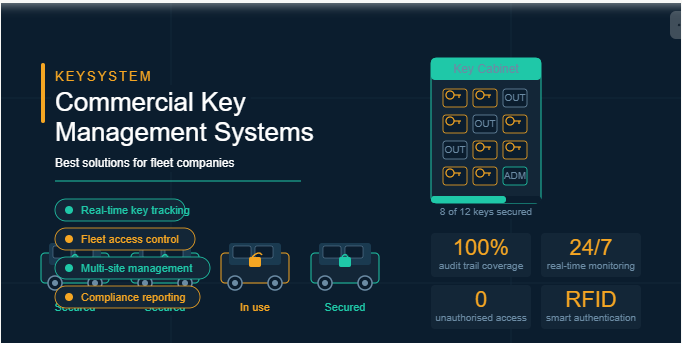
Commercial Key Management Systems: The Smartest Investment Fleet Companies Are Making
Managing keys sounds simple — until you’re running a fleet. A missing vehicle key at 6 AM delays a driver, disrupts a delivery schedule, and costs your business real money. Across industries, fleet operators are discovering that outdated key control methods — pegboards, logbooks, manually signed-out keys — are liabilities dressed up as processes. That’s why commercial key management systems have moved from a “nice to have” to an operational necessity for businesses that run on wheels.
At Keysystem, we work with fleet companies across industries — logistics, construction, transport, utilities, and more — and we’ve seen firsthand how the right solution transforms day-to-day operations. This blog covers everything you need to know: what commercial key management systems are, why fleet businesses need them, and what to look for when choosing the best solution for your operation.
What Are Commercial Key Management Systems?
Commercial key management systems are secure, automated solutions designed to control, monitor, and manage access to physical keys within a business environment. Unlike residential key organizers or basic lockboxes, these systems are built for high-traffic, multi-user environments where accountability, speed, and security must coexist.
A modern commercial key management system typically includes:
- Electronic key cabinets with individual locking key slots
- User authentication via PIN, RFID card, fingerprint, or mobile credential
- Audit trail software that logs every key transaction in real time
- Alerts and notifications for overdue returns, unauthorized access, or missing keys
- Integration capability with fleet management software, HR systems, and access control platforms
These aren’t glorified key hooks. They are intelligent systems that bring discipline and visibility to one of the most overlooked assets in any operation — your keys.
Why Fleet Companies Cannot Afford to Ignore Key Control
Fleet businesses operate with tight margins and zero tolerance for preventable downtime. Yet many still manage vehicle keys informally. Here’s what that actually costs:
Unauthorized vehicle use — Without a commercial key management system, any employee with cabinet access can take a vehicle key without detection. This creates insurance liability, fuel theft, and potential accidents in your company’s name.
Delayed dispatches — When a driver can’t find a key, every minute of delay costs productivity. A manual logbook tells you who signed out a key but nothing about where it is right now.
Key duplication risk — Untracked keys can be copied and returned undetected, creating long-term security vulnerabilities.
Compliance gaps — Industries like transport and utilities often have regulatory requirements around vehicle access. Paper-based key logs rarely meet auditor standards.
Lost key replacement costs — Modern vehicle transponder keys can cost hundreds of pounds to replace. Losing them isn’t just inconvenient — it’s expensive.
These are not hypothetical risks. They are daily operational realities for fleet companies that haven’t yet invested in commercial key management systems.
Best Key Management Solutions for Fleet Companies: What the Market Offers
Searching for the best key management solutions for fleet companies means filtering through a growing market of hardware, software, and hybrid products. Let’s break down the key categories and what distinguishes a genuinely good solution from one that looks impressive in a brochure.
1. Intelligent Electronic Key Cabinets
The foundation of any serious fleet key management setup is an intelligent electronic key cabinet. These units house individual secured key slots — each locked and released based on user authentication. Every transaction is logged automatically.
What makes a cabinet right for fleet use:
- Scalable capacity — From 16-key units for small fleets to 100+ key cabinets for large depots
- Multi-site compatibility — Centralized software that manages cabinets across multiple locations
- Rugged build quality — Fleet environments aren’t office environments. Cabinets need to withstand industrial settings
- Fast access — Drivers have tight schedules. Authentication and key retrieval should take seconds, not minutes
At Keysystem, our key cabinet solutions are designed with fleet operations in mind — fast to deploy, easy to manage, and built to handle the volume a busy depot demands.
2. Cloud-Based Key Management Software
Hardware alone isn’t enough. The best key management solutions for fleet companies pair physical cabinets with powerful software dashboards that give fleet managers complete visibility from any device.
Essential software features for fleet operations:
- Real-time key status — Know instantly which keys are in, which are out, and who has them
- Driver-specific access permissions — Only authorised drivers can access specific vehicle keys
- Automated reporting — Generate compliance-ready reports without manual data entry
- Return reminders and alerts — Automatic notifications if a key hasn’t been returned by a set time
- Integration with fleet telematics — Some advanced platforms connect key data with GPS and mileage tracking
3. Multi-Factor Authentication Options
One of the defining features that separates enterprise-grade commercial key management systems from basic electronic lockers is authentication flexibility. Fleet environments often have workers who don’t sit at desks — they need fast, reliable access methods.
Common authentication methods include:
- PIN codes — Simple and fast, suitable for secure internal environments
- RFID/proximity cards — Ideal for environments where drivers already use access cards
- Biometric fingerprint — Highest level of individual accountability; no card-sharing risk
- Mobile app credentials — Increasingly popular for modern fleets with tech-savvy drivers
The best fleet key management solutions offer multiple authentication options within the same system, so you can match the method to the environment and the user.
4. Audit Trail and Compliance Reporting
For transport companies, logistics operators, and anyone managing commercial vehicles, the audit trail is everything. A good commercial key management system should produce tamper-proof, timestamped records of every key transaction — who accessed which key, when, and for how long.
This data is valuable in multiple ways:
- Internal accountability — Address disputes or investigate incidents with factual logs
- Insurance purposes — Demonstrate due diligence in vehicle key control
- Regulatory compliance — Meet industry standards and operator licence requirements
- HR and disciplinary processes — Objective records remove subjectivity from investigations
Look for systems that store data securely (ideally cloud-hosted with backup) and allow easy export for audits and reporting.
5. Scalable, Multi-Site Management
Fleet companies rarely operate from a single location. The best key management solutions for fleet companies are built to scale — starting with one depot and expanding to cover an entire national operation through a single software platform.
Centralised management means:
- One login for all sites
- Consistent access policies applied across every location
- Aggregated reporting across the entire fleet
- Remote troubleshooting and user management without on-site visits
This is where commercial key management systems prove their enterprise value. It’s not just about controlling keys at one site — it’s about controlling them everywhere, consistently.
5 Signs Your Fleet Needs a Commercial Key Management System Now
Still on the fence? Here are five clear indicators that your current approach isn’t working:
- You’ve had at least one key go missing in the last 12 months — One lost key is an incident. A pattern is a system failure.
- You can’t tell in real time who has which vehicle key — If you have to ask around to find a key, you’ve already lost control.
- Your drivers wait for keys during shift changes — Manual key handovers create queues and delays that compound over a week.
- Your audit logs are paper-based — Paper logs can be falsified, lost, or simply never filled in properly.
- You’ve had an unauthorized vehicle use incident — This is the highest-stakes warning sign. An untracked vehicle is an uninsured liability.
The Business Case: ROI of Investing in Fleet Key Management
Fleet managers often ask whether the investment in commercial key management systems is justified. The answer is almost always yes — and quickly.
Consider the following:
| Cost Without a System | Savings With a System |
|---|---|
| One lost transponder key: £200–£500 | Eliminated with tracked, returned keys |
| Unauthorized vehicle use incident: £1,000–£10,000+ | Prevented by access-controlled release |
| Compliance audit failure: significant fines | Audit-ready reports on demand |
| Dispatcher time managing key queries: 30+ mins/day | Automated real-time visibility |
| Driver delays at shift start: 5–15 mins per incident | Instant authenticated access |
Choosing the Right Partner, Not Just the Right Product
The market for commercial key management systems includes many hardware providers selling similar-looking cabinets. What separates a good investment from an expensive mistake is the partner behind the product.
When evaluating providers, ask:
- Do they offer post-installation support or just sell hardware?
- Can the software integrate with your existing fleet management tools?
- Is the system scalable as your fleet grows?
- Do they have verifiable experience with fleet operations specifically?
- What does their training and onboarding process look like?
At Keysystem, we don’t just sell key cabinets — we build long-term key management programmes that grow with your business.
📞 Contact Keysystem today